A Simple Guide to Demand Forecasting
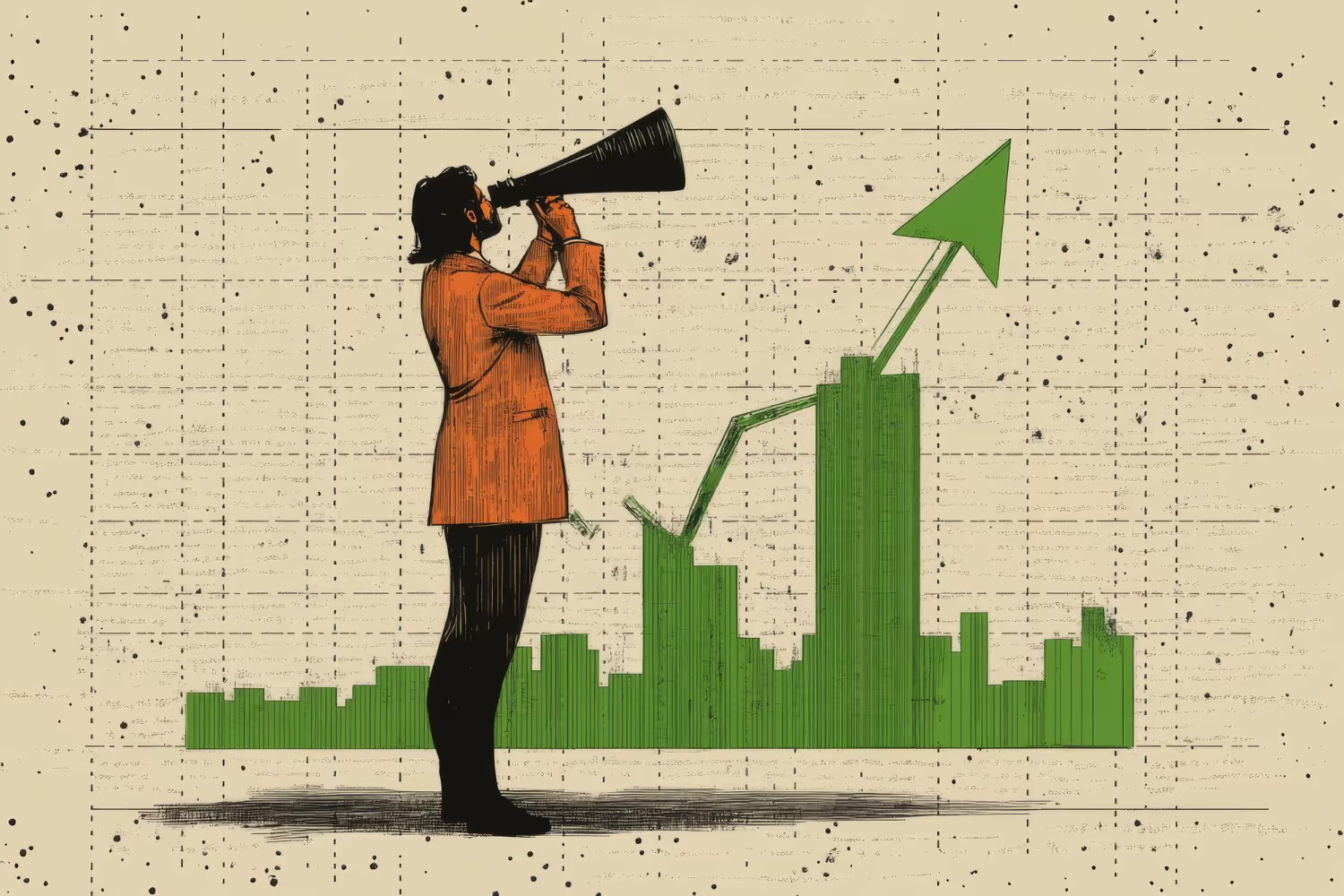
Every product business lives between two bad outcomes. On one side, you sell out of your bestseller halfway through the month and watch customers drift off to a competitor. On the other hand, your stockroom fills up with boxes of something that just won't shift, and your cash sits trapped inside them.
Both come from the same place: a guess about how much you were going to sell. Demand forecasting is simply how you make that guess a better one.
It sounds like the kind of thing that needs a data team and a wall of dashboards. It doesn't. At its simplest, forecasting means looking at what you have sold before, adjusting for what you know is coming, and using that to decide what to buy. Here is how to do it well.
What demand forecasting really means
Demand forecasting is predicting how much of each product you will sell over a set period, so you can buy the right amount at the right time.
You are not trying to see the future perfectly. You are trying to be roughly right instead of badly wrong, often enough that your stock levels stop being a weekly source of stress.
What goes into a useful forecast
A good forecast doesn't need to be complicated. It needs a few honest inputs:
- Your sales history. This is the foundation. What sold, when, and how quickly gives you a baseline to build on.
- Seasonality and trends. A garden brand sells very differently in June than in December. And if a product is climbing or fading, last month tells you more than last year.
- Supplier lead times. Knowing you will sell 200 units is only half the picture. If your supplier takes eight weeks to deliver, you need to order long before you run low.
- Promotions and campaigns. A forecast that ignores the flash sale you have planned will always be wrong. Anything that will move demand needs to go in.
Turning a forecast into a decision
A forecast on its own doesn't keep you in stock. The decisions do, and two simple ideas connect the two:
- Reorder point: The stock level that tells you it is time to buy again, worked out from how fast a product sells and how long your supplier takes to restock you. When the stock drops to that number, you place the order.
- Safety stock: A small buffer for the things you can't plan for, like a supplier delay or a video that takes off overnight. Enough to cover you, not so much that you have quietly drifted back into overstocking.
When spreadsheets stop coping
Plenty of brands start with a spreadsheet, and for a while, it works fine. The trouble arrives with growth.
Add more products, more sales channels, and a second warehouse, and the number of things to track multiplies. Your sales data is now spread across Shopify, Amazon, and wholesale. Stock sits in two locations. The spreadsheet that once took an hour now takes most of a day, and it is out of date by the time you have finished it.
That is usually the moment forecasting stops happening. It becomes too big a job to do by hand, so people fall back on gut feel, and the stockouts and overstock creep back in.
Where a system takes over the heavy lifting
This is where dedicated inventory planning earns its place. Instead of pulling numbers together by hand, the system reads your real sales data and does the forecasting for you. A Retail-First ERP like Brightpearl by Sage builds this in:
- Forecasts from your real sales across every channel and location, rather than a spreadsheet kept on the side.
- Buying recommendations that tell you what to order, how much, and when.
- Seasonality and trends are factored in automatically, so a predictable spike doesn't catch you out.
Brands that make the switch tend to describe the same relief: the guesswork goes, and the team stops firefighting stock. One Brightpearl customer, AYBL, saves around 100 hours a month through automated forecasting.
Where to start
You don't need a perfect model to feel the benefit. Start by writing down what you actually sold over the last year and looking for the patterns: the seasonal lifts, the steady earners, the items that never quite moved. Add in what you know is coming. That alone will put you well ahead of pure instinct.
From there, as the spreadsheet starts to creak, a system can take the weight off your hands. Forecasting was never about predicting the future flawlessly. It is about being caught out far less often.
Ready to take the guesswork out of what to buy?
The DTC Live Newsletter
Subscribe to get weekly eCom insights straight to your inbox.